
Hello,
Welcome to Day 2 of Pizza School!
OK, now that we understand why a high-hydration dough is the best dough to use in a home oven, let's talk about the only four ingredients you need to make excellent pizza dough:
- Yeast
- Flour
- Salt
- Water
Let's explore each:
 |
Yeast
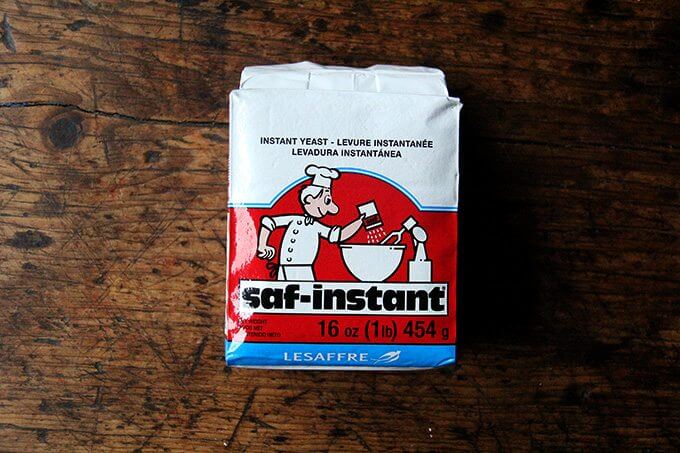
Yeast is what will make your pizza rise, and my preference for all pizza and bread recipes is SAF Instant Yeast. The beauty of instant yeast is that you can stir it directly into the flour — no need to "proof" or "bloom" it.
If you have active dry yeast on hand and would like to use it up, go for it: simply sprinkle it over the lukewarm water and let it stand for about 10 minutes or until it gets foamy before adding to the other ingredients.
(If you would prefer to make pizza with a sourdough starter, follow this Sourdough Pizza Crust Recipe. It also calls for only four ingredients (or three, actually): flour, water, salt, and sourdough starter, which is a fermented mix of flour and water that contains wild yeast and bacteria.)
Flour: Tipo 00 vs. Bread vs. All-Purpose
Tipo 00 flour is the flour requisite in the production of D.O.C. Neapolitan pizza. Contrary to popular belief, the "00" is not an indicator of protein content. It refers, rather, to the fineness of the milling, "00" being the finest grade in the Italian classification system.
If you have ever swapped in tipo 00 flour for whatever flour you are using in your favorite pizza dough recipe, you may have noticed a difference in the texture of the mixed dough — it likely was wetter — as well as a difference in how it handled — it likely extended more easily when stretching it into a pizza round.
There was a period during which I used tipo 00 flour exclusively, but today I find I get just as good results when I use bread flour or all-purpose flour, King Arthur Flour being my favorite brand.
What is the difference between the two? Mostly the protein content. KAF bread flour has a higher protein content (12.7% protein) than the all-purpose flour (11.7% protein).
A dough made with bread flour as opposed to all-purpose flour will absorb slightly more liquid and will therefore be slightly stiffer. If you live in a humid environment and often find your bread and pizza doughs to be too wet and therefore tricky to handle, using bread flour may help.
I must confess I am constantly changing my opinion about what type of flour makes the best pizza and this, I've learned, is because the flour itself is constantly changing from season to season and from year to year.
Moreover, every brand of flour absorbs water differently. For instance, King Arthur Flour's 00 flour will absorb water differently than Giusto's 00 Flour and Caputo's 00 flour. Each of these varieties of 00 flour will taste differently, too. Same goes for different brands of all-purpose and bread flours.
In sum, the key is to use good flour, always unbleached and unbromated. And I encourage you to experiment. What works best for me in my environment might not work as well for you in yours.
Salt
Salt is essential in pizza dough for two reasons: it provides flavor and it strengthens the gluten. The amount of salt in a pizza dough recipe should be 2 - 3% the weight of the flour. For the dough recipe I use, this range is 11 to 15 grams.
Remember in email #1 when I said "making good pizza at home comes down to nailing a few simple details"? Truly, I think 75% of making good pizza comes down to using a sufficient amount of salt given the amount of flour you are using.
For pizza dough, my salt preference is Diamond Crystal kosher salt or Baleine fine sea salt, both of which dissolve quickly.
For finishing, I love Maldon sea salt. I finish nearly every pizza I top with a drizzle of olive oil and a pinch of sea salt.
Water
I have no trouble using cold water from my tap, which I mix with boiling water to create perfectly lukewarm water (see recipe box for details). That said, if you suspect your water is adversely affecting your pizza dough, here are two tips:
- Use water that you've left out overnight to ensure any chlorine has evaporated.
- Buy spring water. In some places, letting water sit out overnight will not be effective.
Ingredients You Don't Need
Contrary to what you may have read, you do not need to include any sweetener or olive oil in your pizza dough. You also don't need ingredients that promote browning, such as diastatic malt . Find out why here.
This concludes Lesson #2. See you tomorrow, when I'll share a tip for how to best handle high-hydration pizza doughs.

Love what you're reading? Click here to receive an alert every time I post a new recipe.
Unsubscribe | Update your profile | 2215 Nott St #152 , Niskayuna, NY 12309

No comments:
Post a Comment