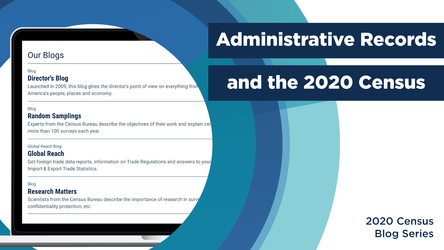
Modernizing Federal Statistics At the Census Bureau, trailblazing is part of our DNA. We strive to innovate and advance the science behind the nation's statistical infrastructure to help tell the story of the nation's people, places, and economy. Big data. Limitless cloud storage. Artificial intelligence. Faster processing. Growing broadband access. We are working to safely and securely leverage these and other modern-day tools to produce the data the nation needs. Explore our new Transformation web page to learn about our experimental surveys, technology advancements, and more.  Administrative Records and the 2020 Census Each decade we are asked, "Why don't you just use the information the government already has about me for the census? Why ask me again?" In some ways, we do. We regularly work with information from other government agencies to make our statistics more accurate. For example, we have used information from federal, state, and local government agencies for decades to improve our census address list and to create population estimates. For the 2020 Census, we accepted the challenge from the public and Congress to use existing records even more to streamline census operations, reduce the burden on people who respond, and save taxpayer money. Characteristics of Adults in Same-Sex and Opposite-Sex Couples by State There were roughly 980,000 same-sex couple households in the United States in 2019 and most were married — around 58% compared to 42% unmarried. In our new data visualization, you can explore characteristics of same-sex and opposite-sex married and unmarried couple households at the state level in 2019 thanks to the American Community Survey. Please note that this data visualization is best viewed on a laptop or desktop computer. Working from Home During the Pandemic More than a third of U.S. households reported working from home more frequently than before the pandemic, but the percentage who made the switch varied widely across sociodemographic groups. Households with members who teleworked more frequently reported higher levels of income and education and better health than those in which no one changed their typical in-person work in response to the COVID-19 pandemic. | 




No comments:
Post a Comment