Reaching out to care self-funders 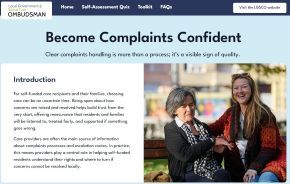 Do you or a loved one receive care that is arranged without the involvement of the local council? If you're receiving this newsletter, you may already know we can investigate complaints about 'self-funded' care. However, these types of complaints - about independent care providers - remain a small proportion of all the care complaints we receive, despite self-funded care making up a significant chunk of all the paid-for care given in England. For this reason, last week we launched a campaign to help care providers reflect on whether they are 'complaints confident'. We've put together lots of useful resources which highlight what a good approach to complaints looks like, which includes telling their customers and families about their right to come to us if they have an unresolved complaint. We understand why the subject of complaining may feel uncomfortable at the point when people are choosing care. But being open about how concerns can be raised is important, and can reflect an organisation willing to listen and learn. The campaign is targeting care providers in the South East initially, but anyone can see our website and whether their care provider – or the one they are considering using – meets our best practice. | Complaint Code launches  On Thursday 26 March, we held our Complaint Handling Code launch event in London, bringing together a diverse group of council officers, sector bodies and fellow Ombudsmen to explore the Code in practice. Attendees heard how we plan to apply it in our casework, and shared best practice with colleagues from across the sector. The day featured contributions from the Ethics and Integrity Commission, who spoke about their current review into public sector Ombudsmen services, and from the Blavatnik School of Government at the University of Oxford, who presented their research into the long-term impact of our work. We were also delighted to hear from Liverpool City Council, who shared their transformation journey to improve complaint handling - and how the Code played a meaningful role in that process. The event closed with an open panel session, giving delegates the chance to put their questions to speakers on the day's presentations and on complaint handling improvement more broadly. The Complaint Handling Code sets out how organisations we investigate should handle complaints fairly and effectively. It helps resolve issues quickly, improve services using complaint data, and build a positive culture around complaint handling. | Stronger visiting rights in care and health settings  The government has announced plans to strengthen visiting rights for people in care homes, hospitals and hospices, following a review of CQC Regulation 9A, which came into force in April 2024. The review found that many people continue to face barriers to visiting, including blanket restrictions and exclusion from decisions about care. In response, the government has said it will issue clearer guidance to providers, work with the Care Quality Commission to monitor compliance, and explore legislation to further embed visiting rights across health and social care. If you have experienced difficulties visiting a loved one in a care setting and your concerns have not been resolved, we may be able to help. We investigate complaints about adult social care providers independently, impartially and free of charge. Visit lgo.org.uk to find out more or to make a complaint. | Giving our views on SEND Earlier this month, we were pleased to accept an invitation to speak at the 2026 SEN Law Conference. Our Assistant Ombudsman, Sharon Chappell, gave a talk about closing the accountability gap for children with Special Educational Needs and Disabilities (SEND) in schools. Coming shortly after the Government's launch of its White Paper setting out plans for reforming the education system, the event was an important opportunity for people all across the sector to debate the new developments. Our insights focused on how an equal system of redress for all parts of the education system is crucial for children with SEND and their families to have a fair say. For organisations to be held properly accountable for delivering their statutory duties there must be independent oversight of complaints for all parts. Sharing learning to improve services March was a busy month for our team. We responded to three government consultations: one from the Ministry of Housing, Communities and Local Government on proposed changes to the National Planning Policy Framework, and two from the Department for Education - on fostering reform and the establishment of a new Child Protection Authority in England. Our consultation responses are grounded in real-world evidence drawn directly from our casework. For the planning consultation, we were able to draw on cases we have handled involving the planning system, while our responses on fostering and child protection were informed by cases relating to how local authorities administer these vital services. This ensures that the experiences of the people who come to us are reflected in national policy discussions. Easter hours  | | We will be closing our advice line for Easter at 1pm on Thursday 2nd April. This will reopen at 10am on Tuesday 7th April. Our online complaints system will also be closed from 5pm on Thursday till 8am on Tuesday. | News you may have missed... | 







No comments:
Post a Comment